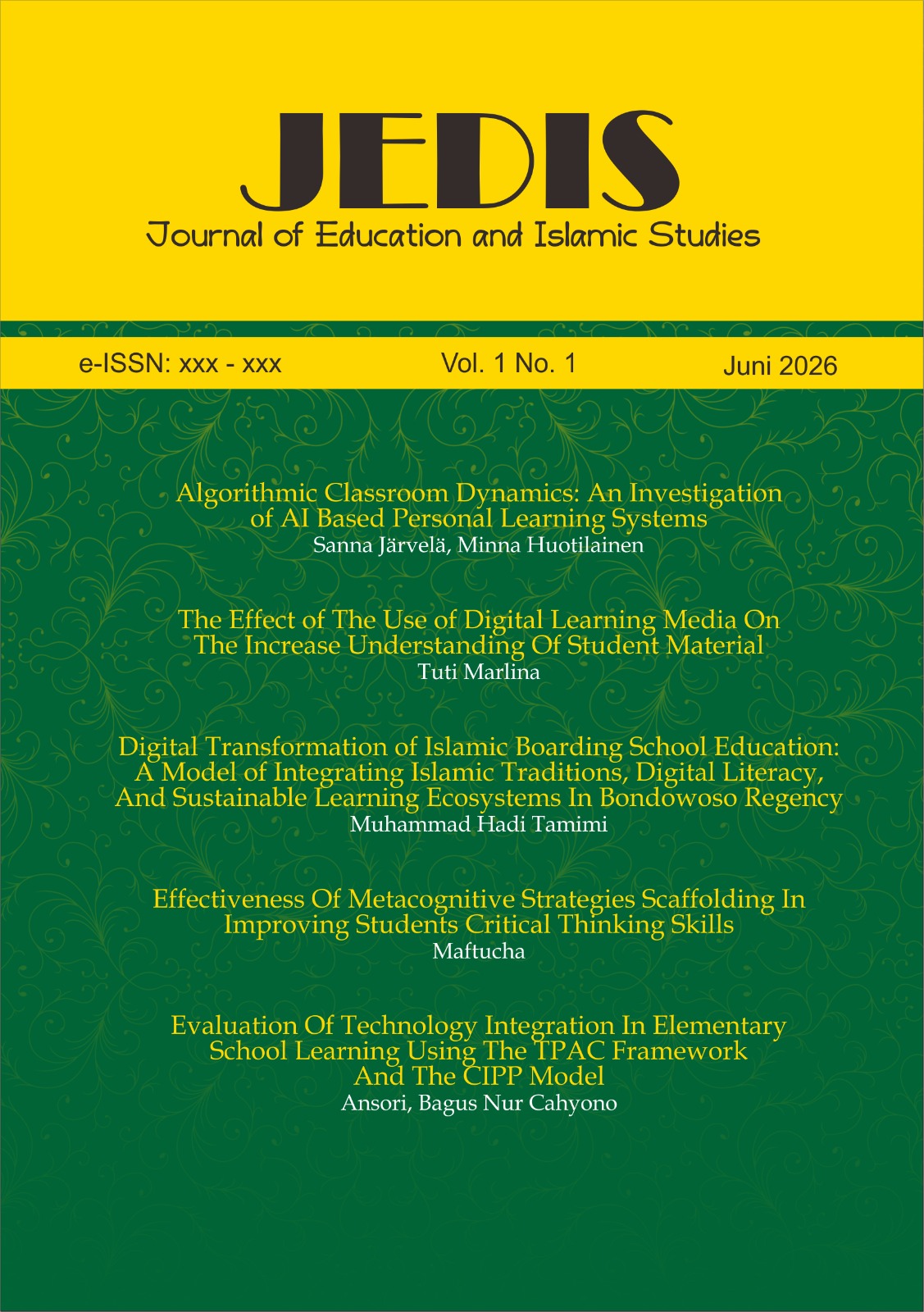
ALGORITHMIC CLASSROOM DYNAMICS: AN INVESTIGATION OF AI BASED PERSONAL LEARNING SYSTEMS
DOI:
https://doi.org/10.322154/x14d6n53Keywords:
Artificial Intelligence, personalized learning, algorithmic classroom dynamics, digital pedagogy, Finnish education.Abstract
Digital transformation in education has encouraged the use of Artificial Intelligence (AI) to create a more personalized and adaptive learning system. Finland is one of the countries that has successfully integrated AI in learning through an approach oriented to the individual needs of students. This study aims to analyze how AI-based personalized learning systems shape classroom dynamics in Finnish rural public schools. The research used a qualitative approach with multiple case study designs conducted at Saunalahti Comprehensive School (Espoo), Puistola Comprehensive School (Helsinki), and Mäntynummi Comprehensive School (Lohja). Data were collected through non-participatory observation, in-depth interviews, and document analysis, then analyzed using thematic analysis through the process of data reduction, coding, data presentation, and conclusion drawing. The results show that the implementation of AI is able to transform classroom dynamics through personalization of learning paths, provision of real-time feedback, and strengthening data-driven pedagogical decision-making. The role of teachers shifts from conveyors of information to facilitators who utilize algorithmic recommendations to provide more targeted learning interventions. This research offers the concept of Algorithmic Classroom Dynamics as a new conceptual contribution that explains how AI algorithms affect pedagogical interactions, the distribution of teacher roles, and the learning experience of learners in a personalized learning environment. These findings are expected to be a reference in the development of AI implementation policies that continue to prioritize pedagogical values and educational inclusivity.
References
Arkorful, V. E., Basiru, I., Anokye, R., Latif, A., Agyei, E. K., Hammond, A., Pokuaah, S., Arkorful, E. V., & Abdul-Rahaman, S. (2020). Equitable Access and Inclusiveness in Basic Education: Roadblocks to Sustainable Development Goals. International Journal of Public Administration, 43(3), 189–202. https://doi.org/10.1080/01900692.2019.1627554
Creswell, J. W. , & P. C. N. (2018). Qualitative Inquiry and Research Design: Choosing Among Five Approaches. Sage Publications.
Ghamrawi, N., Shal, T., & Ghamrawi, N. A. R. (2024). Exploring the impact of AI on teacher leadership: regressing or expanding? Education and Information Technologies, 29(7), 8415–8433. https://doi.org/10.1007/s10639-023-12174-w
Gligorea, I., Cioca, M., Oancea, R., Gorski, A.-T., Gorski, H., & Tudorache, P. (2023). Adaptive Learning Using Artificial Intelligence in e-Learning: A Literature Review. Education Sciences, 13(12), 1216. https://doi.org/10.3390/educsci13121216
Hariyanto, Kristianingsih, F. X. D., & Maharani, R. (2025). Artificial intelligence in adaptive education: a systematic review of techniques for personalized learning. Discover Education, 4(1), 458. https://doi.org/10.1007/s44217-025-00908-6
Jauhiainen, J. S., & Garagorry Guerra, A. (2024). Generative AI and education: dynamic personalization of pupils’ school learning material with ChatGPT. Frontiers in Education, 9. https://doi.org/10.3389/feduc.2024.1288723
Kucirkova, N., & Leaton Gray, S. (2023). Beyond Personalization: Embracing Democratic Learning Within Artificially Intelligent Systems. Educational Theory, 73(4), 469–489. https://doi.org/10.1111/edth.12590
Lechuga, C. G., & Doroudi, S. (2023). Three Algorithms for Grouping Students: A Bridge Between Personalized Tutoring System Data and Classroom Pedagogy. International Journal of Artificial Intelligence in Education, 33(4), 843–884. https://doi.org/10.1007/s40593-022-00309-y
Lincoln, Y. S. , & G. E. G. (1985). Naturalistic Inquiry. Sage Publications.
Maghsudi, S., Lan, A., Xu, J., & van der Schaar, M. (2021). Personalized Education in the Artificial Intelligence Era: What to Expect Next. IEEE Signal Processing Magazine, 38(3), 37–50. https://doi.org/10.1109/MSP.2021.3055032
Meng, X., Yang, B., Yang, L., Zhang, J., & Liu, Y. (2025). A Novel AI-Empowered, Student-Centered Teaching Strategy for Large Classes in Higher Education. International Journal of Science and Mathematics Education, 23(7), 3093–3121. https://doi.org/10.1007/s10763-025-10573-8
Miles, M. B. , H. A. M. , & S. J. (2020). Qualitative Data Analysis: A Methods Sourcebook. Sage Publications.
Peng, J., & Li, Y. (2025). Frontiers of Artificial Intelligence for Personalized Learning in Higher Education: A Systematic Review of Leading Articles. Applied Sciences, 15(18), 10096. https://doi.org/10.3390/app151810096
Retno Anggraini, Ansori Ansori, Natal Kristiono, Rinovian Rais, & Budi Mardikawati. (2025). Curriculum Analysis Of The Character Education System In Indonesia And Malaysia. Journal of International Multidisciplinary Research, 3(3), 9–16. https://doi.org/10.62504/jimr1217
Sajja, R., Sermet, Y., Cwiertny, D., & Demir, I. (2025). Integrating AI and Learning Analytics for Data-Driven Pedagogical Decisions and Personalized Interventions in Education. Technology, Knowledge and Learning. https://doi.org/10.1007/s10758-025-09897-9
Saunders, B., Sim, J., Kingstone, T., Baker, S., Waterfield, J., Bartlam, B., Burroughs, H., & Jinks, C. (2018). Saturation in qualitative research: exploring its conceptualization and operationalization. Quality & Quantity, 52(4), 1893–1907. https://doi.org/10.1007/s11135-017-0574-8
Sun, S., & Cheng, Z. (2026). AI‐Driven Adaptive Education Systems: A Comprehensive Review of Concepts, Models, and Future Possibilities. Computer Applications in Engineering Education, 34(4). https://doi.org/10.1002/cae.70215
Vartiainen, H., Kahila, J., Tedre, M., López-Pernas, S., & Pope, N. (2025). Enhancing children’s understanding of algorithmic biases in and with text-to-image generative AI. New Media & Society, 27(9), 5342–5368. https://doi.org/10.1177/14614448241252820
Wang, W., Wang, Y., Chen, J., Wang, X., Zhang, H., Guo, C., & Peng, Y. (2026). The Effectiveness of AI-Supported Personalized Feedback on Students’ Learning Outcomes and Motivation: A Meta-Analysis. Journal of Educational Computing Research, 64(3), 724–755. https://doi.org/10.1177/07356331251410020
Whang, J., & Lee, C.-H. (2024). Effects of AI-Based Personalized Education on the Rural Students’ Math Learning Skills. The Institute for Education and Research Gyeongin National University of Education, 44(1), 1–16. https://doi.org/10.25020/je.2024.44.1.1
Yang, H. H., Zhu, S., & MacLeod, J. (2018). Promoting Education Equity in Rural and Underdeveloped Areas: Cases on Computer-Supported Collaborative Teaching in China. EURASIA Journal of Mathematics, Science and Technology Education, 14(6). https://doi.org/10.29333/ejmste/89841
Yin, R. K. (2018). Case Study Research and Applications: Design and Methods. Sage Publications.
Downloads
Published
Issue
Section
License
Copyright (c) 2026 Sanna Jarvela, Minna Huotilainen (Author)

This work is licensed under a Creative Commons Attribution 4.0 International License.